Walking into an art gallery for the first time produces a specific kind of feeling that is hard to describe accurately. There is wonder in it, genuine and immediate, the sense of standing in front of something made by human hands that carries meaning beyond its surface. But there is also something else. A slight uncertainty about whether you belong there. A quiet anxiety about doing the wrong thing, saying the wrong thing, standing too close or too far, staying too long or leaving too soon. That feeling is more common than most first-time visitors realize, and it has kept more people away from galleries than any admission price or inconvenient location ever has. The truth is that art galleries are not the intimidating, hushed temples of cultural authority that their reputation sometimes suggests. They are places built for exactly the experience you are hoping to have: a genuine encounter with art. Art gallery etiquette is not a set of rules designed to make you feel unwelcome. It is a set of principles designed to protect the art and the experience for everyone in the room, including you. Understanding them before you walk in transforms the anxiety into confidence, and confidence is what allows the real experience to begin.
Why Art Gallery Etiquette Matters More Than You Think
The rules that govern behavior in art galleries exist for reasons that go deeper than institutional formality or social convention. They protect objects that are, in many cases, genuinely irreplaceable. A painting that has survived three hundred years is not invulnerable simply because it has survived. The oils in a canvas painting are chemically sensitive to the acids in human skin. The humidity created by breathing near a work can affect its surface over time. The vibration created by sound at certain frequencies can stress the physical structure of sculptures and ceramics. These are not theoretical concerns invented to justify restrictive policies. They are real physical vulnerabilities that gallery and museum conservators manage every single day, and the behavioral guidelines visitors follow are one of the primary defenses against damage that no amount of conservation expertise can fully undo after the fact. Beyond preservation, art gallery etiquette also exists to protect the quality of the experience itself, for every visitor in the room simultaneously. An art gallery is one of the few remaining public spaces where sustained attention and quiet contemplation are not just permitted but actively supported by the environment. The subdued lighting, the careful spacing of works, the controlled acoustics: all of these are designed to create conditions where a person can stand in front of a work of art and actually see it, think about it, feel something about it without constant interruption. When individuals disregard behavioral norms in gallery spaces, they do not only affect their own experience. They diminish the experience of every other person in the room who came for the same reason they did. Understanding this is the foundation of genuine gallery etiquette: it is not about following rules for their own sake. It is about recognizing that you are sharing something precious with others who value it as much as you do.
Preparing for Your Visit Before You Arrive
Researching the Gallery and Current Exhibition
The most overlooked dimension of art gallery etiquette is everything that happens before you walk through the door, and the visitors who have the richest gallery experiences are almost always those who arrived with some preparation. Researching the gallery and the exhibition you are planning to visit does not require academic art history knowledge or hours of study. It requires thirty minutes of genuine curiosity and an internet connection. Most galleries publish detailed information about current and upcoming exhibitions on their websites, including exhibition essays, artist statements, and contextual information about the works on display. Reading these before your visit gives you a framework that makes the actual encounter with the work significantly more meaningful. You walk in already understanding something about what the artist was trying to do, which means you can spend your time in front of the work feeling and thinking rather than starting from zero. Practical preparation is equally important. Confirm the gallery’s opening hours, admission requirements, and any specific policies about photography, bags, or guided tours before you visit. Many galleries have specific rules that differ from what visitors assume, including bag size restrictions that require checking large bags at the entrance, photography policies that differ between temporary exhibitions and permanent collections, and reservation requirements for popular exhibitions that fill to capacity. Arriving unprepared for any of these practical requirements starts the visit with friction that sets an unnecessarily difficult tone for everything that follows.
Dressing Appropriately for the Gallery Environment
Clothing for a gallery visit is a topic that makes some people unnecessarily anxious and others unnecessarily dismissive. The honest position is in the middle. Most art galleries and museums do not have formal dress codes and welcome visitors in casual clothing. But the gallery environment does have specific physical characteristics that make certain clothing choices more comfortable and more considerate than others. Gallery floors are almost always hard, either stone, hardwood, or polished concrete, and gallery visits involve significantly more standing and slow walking than most people anticipate. Comfortable footwear that can sustain two to three hours of standing without producing pain is a practical necessity rather than a style suggestion. Shoes with hard soles that produce loud clicking sounds on gallery floors are not prohibited but they do create persistent acoustic disruption in spaces specifically designed for quiet contemplation. Softer-soled footwear is a considerate choice that most experienced gallery visitors make without being told to. Fragrant products including strong perfumes, colognes, and heavily scented hair or skin products deserve attention because gallery spaces have limited ventilation by design, and strong fragrances in enclosed gallery rooms are one of the most common sources of discomfort for other visitors. This is particularly relevant in gallery spaces that house delicate works where environmental control is a conservation priority. None of this requires formal dress or expensive clothing. It requires thoughtfulness about how your presence in a shared space affects other people.
Behavior Around the Artwork Itself
The Distance Rule and Why It Exists
The single most important behavioral principle in any art gallery is maintaining appropriate distance from the works on display, and understanding why this rule exists at a physical and chemical level transforms it from an arbitrary restriction into an obvious necessity. The standard guideline in most gallery and museum contexts is to keep at least arm’s length distance between your body and any work of art, and to never touch any work unless explicit signage indicates that touching is permitted and invited. The reasons are multiple and each is compelling on its own. Human skin, even clean and dry skin, carries oils and acids that transfer to surfaces on contact. These compounds initiate slow chemical reactions with the materials in artworks, including the oils and pigments in paintings, the patina on bronze sculptures, and the surface treatments of ceramics and glass objects. The damage from a single touch may be invisible immediately but accumulates over time and over thousands of visitor touches into visible degradation that conservators can mitigate but never fully reverse. Proximity without touch also matters. The human body constantly releases moisture into the surrounding air through breath and skin transpiration. In the microclimate immediately surrounding a person standing close to a work, humidity levels are meaningfully higher than in the room’s general atmosphere. Many of the materials in artworks, particularly those with organic components like paper, canvas, and wood, are sensitive to humidity fluctuations. The aggregate effect of thousands of visitors standing very close to works over years of exhibition contributes to humidity-related stress that affects the work’s long-term stability. The distance rule is not paranoid overcaution. It is one of the simplest and most effective conservation measures available, and every visitor who follows it is making a small but genuine contribution to the preservation of works that future generations deserve to encounter as well.
Photography, Flash, and the Art of Paying Attention
Photography in galleries is a topic with genuine nuance that the simple binary of “allowed” or “not allowed” does not fully capture. Many galleries permit photography of permanent collection works for personal non-commercial use while prohibiting photography during temporary exhibitions, where intellectual property agreements with artists or lending institutions may restrict image capture. Others prohibit flash photography universally while permitting ambient-light photography freely. Some galleries prohibit all photography without exception, and these policies exist for reasons that deserve respect rather than circumvention. The most important principle around photography in gallery spaces is not the technical question of whether your specific shot is permitted but the behavioral question of whether your photography practice is interfering with other visitors’ experience of the art. A visitor who spends thirty seconds taking a thoughtful photograph and then puts their phone away to look at the work is engaging with the art in a way that incorporates documentation without displacing attention. A visitor who positions themselves in front of a work for five minutes adjusting angles and lighting while a queue of other visitors waits to see the work is using the gallery as a photography studio rather than an art space, and this is a failure of gallery etiquette regardless of whether the specific photography is technically permitted. There is also a deeper question worth considering. The act of photographing an artwork is not the same as the act of experiencing it. Research on attention and memory in gallery contexts consistently shows that visitors who photograph works spend less time looking at them and retain less about the experience than visitors who look without capturing. Putting the phone away occasionally and simply looking, for longer than feels comfortable at first, is one of the most genuinely rewarding things a gallery visitor can do.
Navigating Social Behavior in Gallery Spaces
Volume, Conversation, and Shared Silence
The acoustic environment of an art gallery is not incidental to the experience. It is part of the design. The relative quiet of a gallery creates conditions for a kind of attention that loud, busy environments make impossible. When you are not managing constant incoming audio information, your visual attention deepens and your capacity for sustained looking increases. This is not mysticism. It is basic cognitive science about how attention works when competing sensory demands are reduced. Gallery etiquette around conversation and volume is therefore not about imposing silence as a cultural affectation. It is about protecting a rare kind of cognitive environment that the gallery has been designed to support. Keeping conversations at a genuinely low volume, specifically low enough that people a few feet away cannot follow your words easily, is the practical standard in most gallery contexts. This applies to conversations with companions, to phone calls, which should be taken outside the gallery entirely rather than conducted in hushed tones in the gallery room, and to reactions to the art itself, which can certainly be expressed but benefit from being shared at a volume that does not carry across the room to people who are trying to form their own unmediated responses to the same works. Children in galleries deserve special mention, not because children do not belong in galleries, they absolutely do, but because bringing children to a gallery successfully requires age-appropriate preparation and parental attention throughout the visit. Children who understand in advance what a gallery visit involves, why certain rules exist, and what the works on display actually are, consistently have better and more engaged gallery experiences than those who are brought in without preparation and then managed reactively as behavior problems arise.
Moving Through Gallery Spaces Respectfully
The way visitors move through gallery spaces affects both the quality of individual experience and the collective atmosphere of the gallery environment. Gallery rooms are designed with specific viewing distances and traffic patterns in mind, and moving through them thoughtfully rather than habitually produces better encounters with the work and less friction with other visitors. When approaching a work that is already being viewed by others, waiting at a comfortable distance until space opens rather than crowding forward into the existing viewer’s space is a basic courtesy that most people understand intuitively but occasionally forget in moments of excitement about a specific work. Moving to the side of a gallery room to pass rather than walking between viewers and the works they are looking at is another simple practice that requires only minimal spatial awareness. Backpacks and large bags present specific challenges in gallery spaces because their wearers often underestimate the volume they add to their profile when turning and moving. Most galleries with significant collection works require large bags to be checked at the entrance or carried by hand rather than on the back specifically because the collision risk between backpack-wearing visitors and artworks in tight gallery spaces is a documented conservation concern. Following this policy without resentment is a straightforward expression of the priorities that make gallery spaces worth visiting.
Interacting With Gallery Staff and Other Visitors
How to Engage With Guides and Docents
Gallery guides and docents are among the most underutilized resources available to first-time gallery visitors, and a significant dimension of art gallery etiquette involves knowing how to engage with them in ways that are respectful, enriching, and appropriate to the gallery context. Docents are typically volunteers or staff members with considerable knowledge of the collection and specific expertise in the current exhibition. They are present in gallery spaces specifically to help visitors engage more deeply with the work, and the quality of information and interpretation they can offer substantially exceeds anything available through a standard exhibition label or audio guide. Asking docents questions is not an imposition or an interruption of their duties. It is exactly the use they are there for. Questions about specific works, about the artist’s process or biography, about the historical or cultural context of a piece, or about the curatorial thinking behind the exhibition’s organization are all appropriate and welcome. What does not fall within appropriate visitor-docent interaction is asking gallery staff to take photographs for you, requesting special access to restricted areas or storage facilities, or engaging docents in extended personal conversations that prevent them from being available to other visitors who may need assistance. The relationship between visitor and gallery staff is professional and purposeful, and treating it as such produces better outcomes for everyone.
The Etiquette of Sharing Space With Strangers
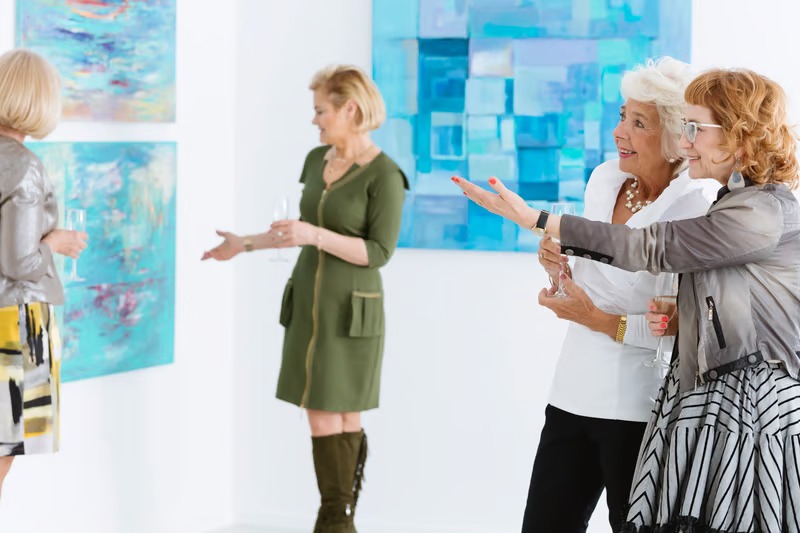
An art gallery is a rare kind of shared space where strangers come together around a common object of attention without any of the social scripts that usually organize encounters between unknown people. This creates a specific social dynamic that first-time visitors sometimes find uncertain but that experienced gallery visitors learn to navigate and even enjoy. It is entirely acceptable to observe what other visitors are looking at and to allow their interest and attention to direct your own. If someone is spending extended time in front of a work you had not planned to spend time with, their absorption is often a meaningful signal worth following. Overhearing another visitor’s conversation about a work and allowing their perspective to inform your thinking is not eavesdropping. It is one of the genuinely valuable serendipities of the shared gallery experience. What falls outside appropriate behavior is initiating unsolicited conversations with strangers who are clearly absorbed in looking, offering unrequested opinions about works other visitors are viewing, or positioning yourself in ways that physically crowd or pressure other visitors away from works they are engaged with. The social norm in most gallery spaces is one of respectful parallel attention: people share space and occasionally share glances of mutual recognition about a particularly powerful work, but they primarily exist in a kind of private contemplative mode that is worth protecting in yourself and in others.
Final Thought
Art galleries are not difficult places. They are not designed for a specific kind of person or a specific level of education or a specific cultural background. They are designed for anyone willing to slow down, pay attention, and allow themselves to be affected by what human beings have made when they were trying to say something that ordinary language could not carry. Art gallery etiquette is the set of behaviors that protects that possibility, for the art, for you, and for every other person in the room who came for the same reason. Walk in curious. Move slowly. Keep your hands to yourself and your voice low. Look longer than feels necessary. And trust that the discomfort of not knowing everything about what you are seeing is not a problem to be solved. It is the beginning of the experience.